
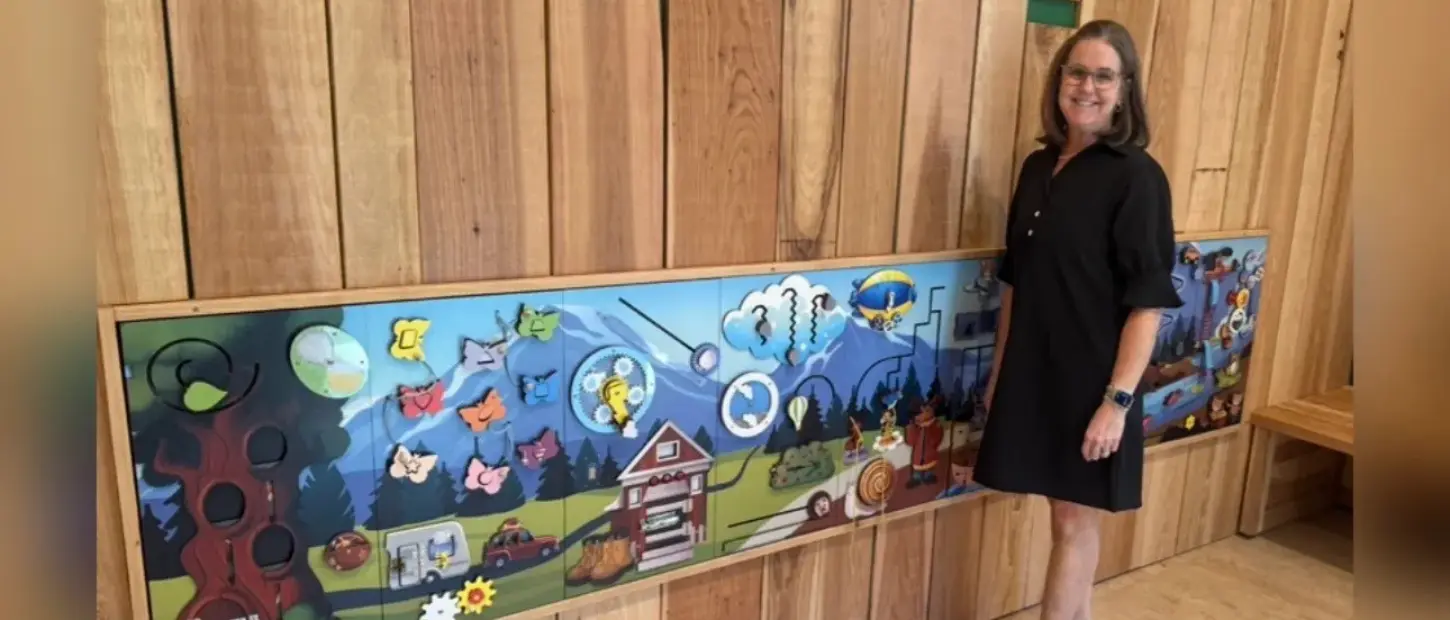
Tracey B. Atwater, president and CEO of Ronald McDonald House Atlanta. (Photo by Adrianne Murchison)
Ronald McDonald House Atlanta is already seeing the demand that prompted leaders to accelerate construction of its new facility on the campus of Children’s Healthcare of Atlanta’s Arthur M. Blank Hospital. Originally planned as a two-phase project, the $81 million facility was completed last year to meet growing demand from families of children receiving medical care.
The five-story house has 110 rooms and is already operating at capacity, serving families who travel more than 50 miles to Atlanta so their children can receive treatment.
By the end of April, more children whose families were staying at the new Ronald McDonald House had died than during all of 2025, said Tracey B. Atwater, president and CEO of Ronald McDonald House Atlanta.
“Part of that is a function of how we are serving more people,” Atwater said.
The increase reflects not only the growing demand for lodging but also the emotional burden carried by families, caregivers, volunteers and staff as they navigate some of the most difficult moments in a child’s medical journey. Recognizing those challenges, Ronald McDonald House intentionally designed its new facility to support families’ emotional well-being and their day-to-day needs.
Set on four acres at 2580 Briarcliff Road, the 126,000-square-foot house was designed by Perkins&Will. It includes community gathering spaces, a wellness room for meditation, yoga and exercise, family and chef’s kitchens, an expansive dining room, family lounges, a discovery garden, a five-story playscape and multiple indoor and outdoor play areas.
A game room features video games, classic pinball machines and board games, while a faux Delta Air Lines cockpit allows children to imagine flying an airplane complete with propellers, controls and simulated air traffic control audio.
“The kids love having this place,” Atwater said. “Part of the magic of the Ronald McDonald House is that you are here with people who get [what you are going through]. There is a play structure on each floor and a living room on each floor.”
The new Briarcliff Road location replaced the Gatewood Road building, which opened in 2008 and has since been sold. Ronald McDonald House Atlanta also operates a 31-room house near Children’s Scottish Rite Hospital on Peachtree Dunwoody Road.
Together, Ronald McDonald House Atlanta’s two locations provided lodging for more than 3,500 families in 2025, the nonprofit says. And nearly 90 percent of families are unable to contribute to the cost of their stay.
Of the new facility’s 110 rooms, 92 are guest rooms for families of hospitalized children, while 18 are transplant suites designed for children recovering from bone marrow or solid organ transplants. Those patients have been discharged from the hospital but must remain within 15 to 20 minutes of the hospital during recovery.
Each transplant suite includes its own air filtration system, private living space, kitchen, washer and dryer, and medical-grade flooring to help protect children with severely compromised immune systems, Atwater said. Families typically stay about 45 days in the transplant suites, and in some cases for several months, compared with seven to nine days for families staying in traditional guest rooms.
“We really work hard to meet families where they are,” she said.
Only about 20% of Ronald McDonald House Atlanta’s operating support comes from McDonald’s, Atwater said. The remainder is provided through philanthropy, corporate partners, and individual donors. The Briarcliff Road location operates with a small staff and nearly 100 volunteers, while more than 50 volunteers serve at the Peachtree Dunwoody Road house.
The nonprofit raises support through events such as the annual Red Jacket Golf Classic, which raised more than $320,000 in May, and a Wine & Fries event scheduled for Sept. 17. Community members and businesses can also support Ronald McDonald House by sponsoring meals prepared in the commercial kitchen, holding volunteer team-building projects at the facility, donating holiday gifts and toys, or making financial contributions to help families remain close to their children while they receive medical treatment.
Even with the expanded facility and a growing network of community support, Atwater said the organization continues to ask families what they need most. Their answers are helping shape Ronald McDonald House’s next chapter.
“We survey every family when they leave, asking, ‘What can we do better? What do you need?’” Atwater said. “Right now, we consistently hear that parents and caregivers could use more support. So we’re trying to find more ways that we can support the caregiver, how can we bring in services that could make a big difference? And are there more things we should be investing in?”